
Breast Imaging Types
Is it time for your exam? If so, you may wonder what type of breast imaging you will experience while visiting our Knoxville, TN center. Our state-of-the-art breast imaging and health services ensure that, no matter what testing you receive, you receive accurate results. These are the types of breast imaging you can expect in our office.
3D Breast Imaging: Digital Mammography
The cornerstone of all breast imaging is mammography, performed yearly. State-of-the-art breast mammography involves digital imaging with tomographic slices, also called 3D mammography. 3D is a bit of a misnomer; tomographic imaging really is a slice-by-slice analysis rather than a 3D analysis.
For example, imagine a loaf of bread. 3D imaging looks at the loaf as a whole, from varying angles. Tomographic imaging looks at each individual slice in the loaf.
High-resolution 4K monitors allow the radiologist to look at the images in great detail, magnify them, and even change the window and contrast levels.
Coupled with AI (to be featured in an upcoming blog), 3D digital mammography provides state-of-the-art breast imaging in the hands of an experienced breast radiologist.
My technologists have heard me say a million times, “Nothing makes me smarter than the old films.” Prior breast mammograms are useful to detect subtle changes over time or to ensure the stability of findings that appear benign. In current practice, most prior imaging can be obtained electronically and merged into our high-resolution interpretation stations.
Breast Ultrasound
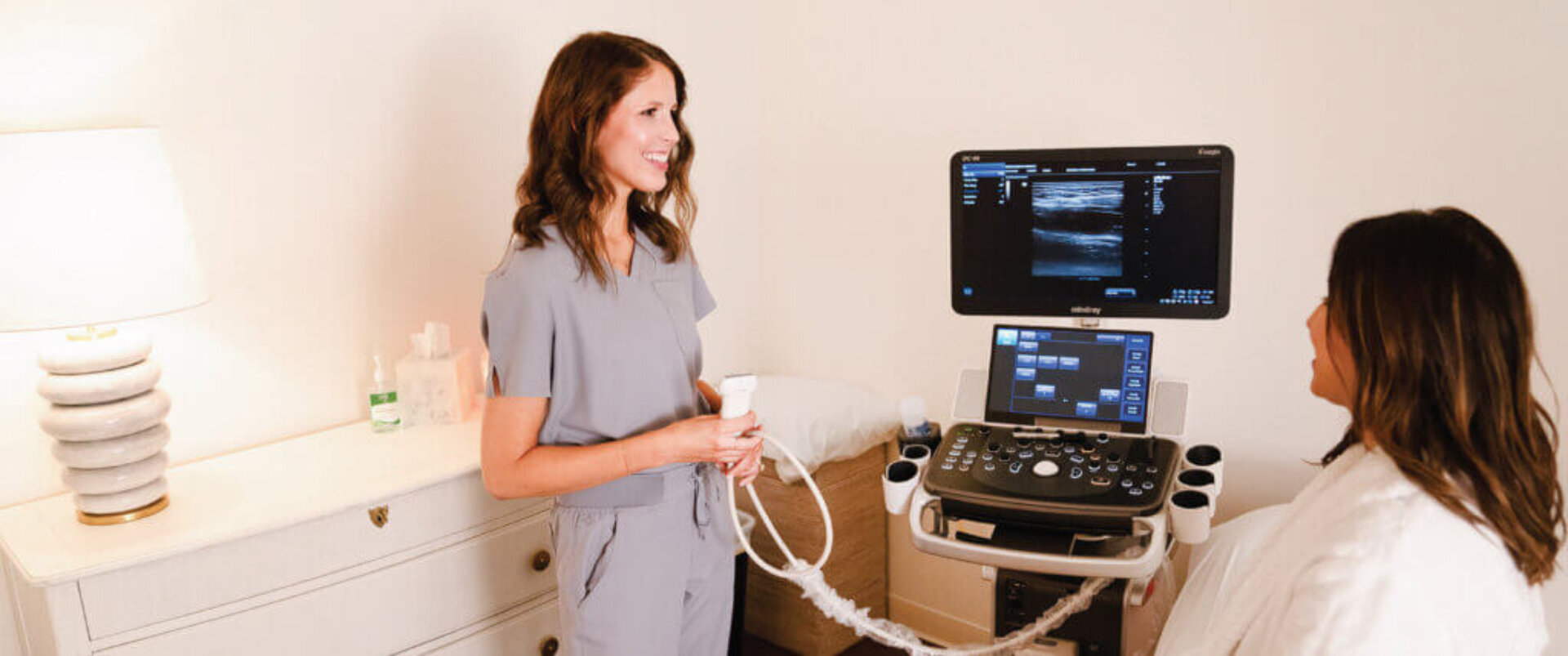
Ultrasound is often the next breast imaging technique.
Most of us are familiar with ultrasound. Many have undergone gallbladder or thyroid ultrasounds or seen the magic of a growing baby in the obstetrician’s office.
In women under the age of 30 with breast lumps, we often start with a breast ultrasound scan. Women who are over 40 who have had breast mammograms typically will undergo ultrasound scanning as well if they have breast implants and/or dense tissue. Dense tissue, which means a lot of fibrous connective tissue and glandular tissue, limits the sensitivity of mammography – even good 3D digital mammography. Forty percent of women have dense tissue.
In our practice, we like to scan all women with dense tissue to obtain a more comprehensive exam. Many times, we have made significant findings with ultrasound that were invisible with mammography.
Breast MRI
Breast MRI is performed yearly in high-risk women and is used in two basic scenarios. The first is in women who have just been diagnosed with breast cancer to help delineate the extent of the disease. The second is in high-risk women; that is, women with a strong family history of breast cancer or who have genetic mutations (such as a BRCA mutation).
It is recommended that women who are at high (greater than 20%) lifetime breast cancer risk undergo a yearly breast MRI. My recommendation is to undergo mammography (and possibly ultrasound), alternating with a breast MRI every 6 months.
Stereotactic Breast Biopsy
A stereotactic breast biopsy uses the mammographic machine to guide the physician into the area in question where a biopsy can be obtained under local anesthetic. We perform stereotactic breast biopsies in the upright position using a specially designed biopsy chair.
I prefer performing such biopsies in the upright sitting position rather than the prone (laying down) position on a table. In my experience, the procedure is more comfortable and takes less time. The procedure takes about 20 minutes to perform, with the biopsy itself taking less than 5 minutes. Pathologic results are available the next day.
Ultrasound Guided Breast Biopsy
Ultrasound guided biopsies are as the name implies – ultrasound imaging is used to guide the biopsy device to the site of a solid mass or distorted breast tissue structure. These biopsies are performed in the ultrasound suite with the patient lying down. The procedure takes 5-10 minutes and is performed using local anesthetic. Like a stereotactic breast biopsy, results are available the next day.
A Word on Biopsy Clips
Biopsy clips are metal and usually made of titanium, an inert metal. Clips are placed for a few reasons. Sometimes, breast cancer is treated with chemotherapy or immunotherapy prior to surgery. In some instances, the cancer has completely “melted away” from the preoperative therapy – leaving only the clip. Thus, the clip provides the guiding landmark to the surgeon.
Clips are placed in and next to benign-appearing lesions. Down the road – when the patient is older or if they are at another imaging facility – the interpreting physicians can clearly see that the “lesion” they see on imaging has been biopsied successfully and was benign; otherwise, it would have been removed.
Biopsy clips are especially important in stereotactic mammographic biopsies for calcifications. The targeted calcifications sometimes are removed completely at the time of biopsy. There may be other groups of calcifications in the same breast that were not targeted. The clip provides guidance to the surgeon facilitating the successful removal of the diseased, cancerous tissue.
Breast Imaging at Mosaic Imaging
At Mosaic Imaging, we strive to provide our patients with an exceptional care experience and to deliver accurate results. Take charge of your breast health by scheduling your breast mammogram today!